
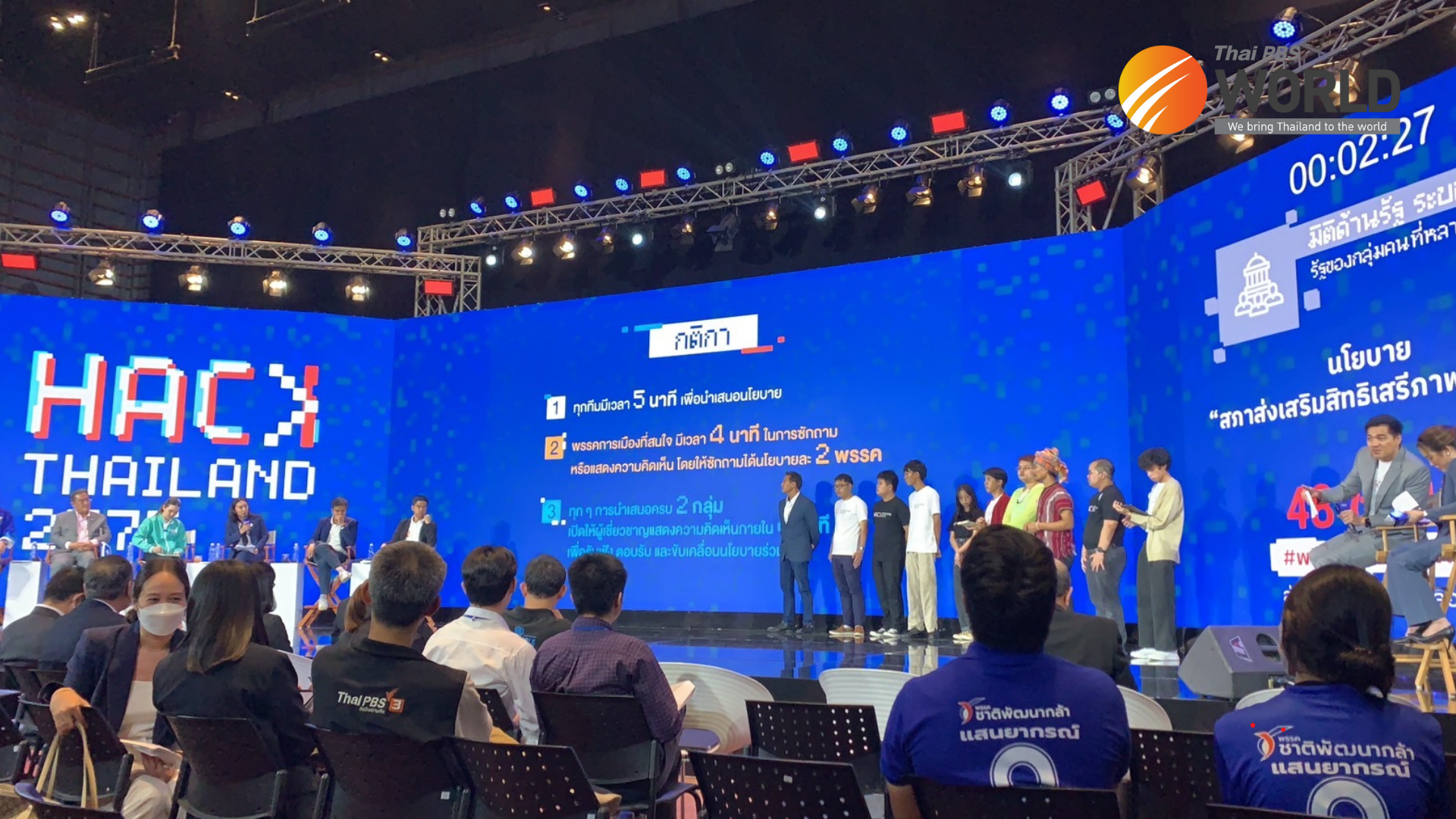

The classic challenge when developing policy is how to formulate government policies which respond to the specific needs of the people. Nowadays, the traditional ways of designing policies, exclusively by those in authority, are changing. There is more public participation, but the lack of platforms for collaboration between stakeholders, the inability to access the legislative process and budget data and a lack of forward thinking remain barriers to Thailand being able to develop a truly inclusive policy making process.
The “Hackathon”, an event involving long hours of brainstorming prototypes, practical steps and deliverables, is becoming a common platform used in policy design. The event gathers people from various backgrounds, such as researchers, entrepreneurs, the marginalized, youth, policymakers and so on, into a group to engage in diverse conversation, exchanges of worldviews, movements and tools to design well rounded policies.
‘Hack Thailand 2023’ hosted by ThaiPBS and many other organization is just such an event, which aims to develop policies for Thailand for the next 10 years, opening up an opportunity for the government sector, policy makers and politicians to collaborate with the civic sector and to draw on data, both empirical and emotional, to bring together government, the civic sector, NGOs and the private sector to work on potential policies. The discussion is divided into health, social, environment, economy, politics and education.
Tanawat Suwannapan, a teacher and an activist, who participates in the design of education policy, emphasises the importance of having a platform for collaboration, as any given policy aimed at just one group of people could affect the whole of society. Therefore, more experiences brought into the policy design process would definitely allow us to see the loopholes or possibilities, which could be, and often are overlooked when only a certain group of people get to design policies.
“When people get to participate, they start to feel a sense of ownership. When people start to talk about things that were once neglected or thought impossible, they will see possibilities and will be hopeful. This could lead to a greater social awareness, or even social agenda which could be pushed towards policies” he adds.
Current limitations in policy making
Apart from the platform on which to work with the government sector, Tanawat also mentioned:
- Regulation limitations: If lawmakers and specialists join the people in the policy making process it would create a key mechanism for adjustment of regulations to fit the policies based on people’s needs.
- The lack of access to budget data: There is insufficient communication about how budgets for the delivery of certain policies are being used or distributed, so no one outside the government has a clear idea where budgets could be adjusted. When all relevant fiscal information is not revealed in a systematic way to the public, it raises questions over budget transparency, which hinders the development process.
“I do believe it is possible to build policy under our current budget system. The point is that it leaves us unable to show where the money will come from for a given policy we introduce or propose to society” Tanawat explained.
Moreover, when policy prototypes are handed on to the political parties, most of them struggle to sustain policy plans and long-term impacts as, when their terms end, most policies are discontinued.
Pannin Sumanasrethakul, Foresight Director at ThailandFuture, suggests an innovative tool called “statistical foresight” be brought into policy making. It is an integrated, forward thinking approach to imagine or anticipate potential future scenarios and rethinking how we can prepare things today to develop and respond to future scenarios.
“This pushes policy making beyond just [alleviating] our current pain towards how we can improve our future” she adds.
In addition, there are private sector associations and organisations who are already at work. They suggest that the government sector can join their platforms, support, promote or certify these entities so that they can help facilitate resources or network for policy implementation.
Sruang Sidhisaman the president of the Thai-Chinese Students Association, who has been working on a “Trilingual Thai” policy prototype to reduce the language barrier for ethnic Thais, also suggests the government consider developing their existing plans and platforms.
“There are several international organisations who have contacted me to find Chinese-speaking new graduates to recruit. They did not reach out through the government. What I am trying to say is that there are already several organisations, associations, business councils, as well as culture and economic councils, which have roles in building interrelationships. The government can use them. Policies and views that we [the private sector] propose to the government should, however, not be used by government alone, because policies would then be less flexible or less viable as regards inclusivity” he remarks.
The policy-making process is a long road involving numerous stakeholders of various identities and needs. In order to carry out policies, we need to ensure that there are sufficient platforms on which people can participate. We also need to promote collaboration between all parties, so that we can develop the best-rounded policies, tools and implementation methods, which leave no one behind as much as possible.
By Atikan Kulsakdinun

