
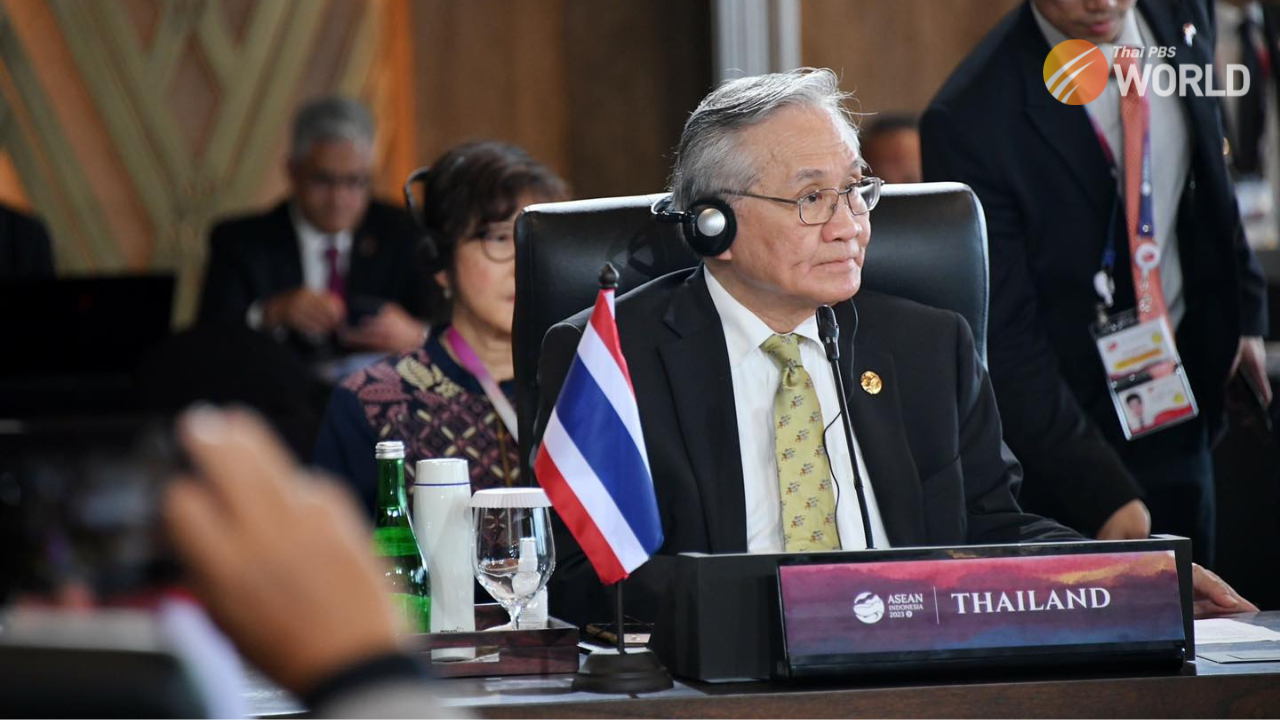

The informal meeting arranged by Thailand’s caretaker government on the Myanmar crisis has only provided a comfort zone for the junta across the border, but dealt a blow to Thailand’s international reputation and deepened divisions within ASEAN, according to experts.
Foreign Minister Don Pramudwinai invited ministers and senior officials from ASEAN and its dialogue partners to the discussions on the ongoing crisis in Myanmar on June 19 in Pattaya, turning a deaf ear to criticism and condemnation domestically and internationally for the reckless initiative of a caretaker government.
Prime Minister General Prayut Chan-o-cha defended the initiative, arguing that his government needed to protect Thailand’s national interests in Myanmar as well as border trade and security.
Thailand has suffered the most from the situation in the neighboring country, as it shares more than 3,000 kilometers of land and maritime boundary. Border trade with Myanmar is worth billions of baht annually and Myanmar is a major source of gas supply for Thailand, he argued.
“We don’t take any sides, but we need to talk to seek solutions to the problems, that’s it. The other things are Myanmar’s internal affairs, and we don’t get involved,” Prayut said.
When asked if it were proper for a caretaker government to host such an international meeting, Prayut said his government had not made any commitments during the meeting and said the next government could solve the problems in its own way.
The Foreign Ministry’s statement said that Thailand under the Prayut government had already held a number of informal meetings on Myanmar in a variety of formats and levels, including twice before at the ministerial level. Prayut’s government hosted a non-ASEAN meeting in December last year and a track 1.5 dialogue in March. Another ministerial meeting mentioned by the ministry was unknown publicly. None of them yielded any concrete results.
New Thai government should avoid recklessness in Myanmar policy, say experts
National interest?
Professor Ukrist Pathmanand of Chulalongkorn University’s Institute of Asian Studies doubted if such a hustled meeting could serve the national interest other than the personal interest of the Thai elite in the caretaker government. Gas concessions in Myanmar might serve the country’s energy security but it also profits big corporates in the sector, he said in an interview with Thai PBS World. “Don’t forget, we have a lobbyist working on Myanmar issues for this caretaker government.”
Myanmar supplies about 15 per cent of Thailand’s total gas needs and the concession is held by Thai conglomerate PTTEP. Officials in Prayut’s government have been working with the Myanmar junta to obtain more concessions, according to diplomatic sources.
A senior official at the Foreign Ministry said a series of meetings in various forms hosted by the government over the past months, including the latest one, were mostly aimed at providing some space to the Myanmar junta in the Thai domestic arena as well as the regional and international community.
The Thai elite and the military, including Prayut himself, have deep connections with Myanmar’s top leader Min Aung Hliang and his cronies. The Myanmar military’s top commander reportedly asked his counterparts in the Thai armed forces to help clear problematic assets belonging to his adult children. The assets were confiscated in Thailand over alleged links to drug trafficking and money laundering committed by an arms dealer and Min Aung Hlaing’s crony, Tun Min Latt, who was arrested last year.
The meeting was also aimed at setting the line and tone for the likely new government led by the Move Forward Party, which has a different policy on Myanmar from that of Prayut’s government, according to Ukrist.
Move Forward Party leader and potential prime minister Pita Limjaroenrat tweeted on June 20 that “we firmly reiterate our support for the actions taken within the ASEAN framework, including those by the previous and current chairs of ASEAN with a view to achieving the goals and objectives established in the Five-Point Consensus.”
Some Myanmar refugees at a shelter in Mae Hong Son catch malaria
ASEAN divide
While the Pattaya meeting was not held within the ASEAN framework, the Foreign Ministry said in its statement that it was aimed at supporting ASEAN efforts to resolve the situation in Myanmar.
Don said in his invitation letter that the meeting would be a part of the initial step of the peace process in Myanmar and cited the previous summit where no member had objected to the idea of ASEAN fully re-engaging with Myanmar at the leadership level. “The meeting marks the first attempt to talk about engagement and re-engagement in all aspects,” he told reporters during the meeting in Pattaya.
A few ministers, including Don, the Myanmar junta’s foreign minister Than Swe, and Lao Foreign Minister Saleumxay Kommasith were present at the meeting. China sent its special envoy to Myanmar, Deng Xijun, India was represented by its ambassador and a foreign ministry director, while the other countries also sent senior officials or ambassadors to the event.
The Pattaya meeting apparently has created a schism in the regional grouping, with Singapore, Malaysia and Indonesia staying away. ASEAN members in mainland Southeast Asia showed solidarity with Thailand, sending their ministers or officials at a high level to the meeting. Vietnam got its ambassador to Thailand, Phan Chi Thanh, to take part.
Retno Marsudi, the foreign minister of Indonesia which currently chairs ASEAN, reminded her Thai counterpart that “ASEAN leaders had held an in-depth discussion on the situation in Myanmar as recently as last month at the 42nd Summit. They had reached no consensus to re-engage or develop new approaches to the Myanmar issue”.
The office of special envoy is engaging with all parties in the strife-torn country to ultimately achieve an inclusive dialogue to settle the political crisis, she said in a letter to Don. “I, too, am doing my part at the foreign ministers’ level,” Marsudi wrote in the letter seen by Thai PBS World, and noted that there was no rush for another meeting as ASEAN foreign ministers will meet in the next round to discuss the matter in less than four weeks’ time.
Malaysia’s Foreign Ministry said in a statement that Minister Zambly Abd Kadir could not attend the meeting and reminded his Thai counterpart that the Five-point Consensus adopted in April 2021 with the consent of Min Aung Hlaing remained a valid reference and mandate in addressing the Myanmar issue. Malaysia maintained its support for efforts made by the ASEAN chair and particularly the office of special envoy, it said.
Singapore’s Foreign Minister Vivian Balakrishnan said during a visit to Washington that it was premature to re-engage with the Myanmar junta at the leader or even at the foreign minister level.
By Thai PBS World’s Regional Desk

